
Benefits of Jiu-Jitsu for Adults & Self-Defense
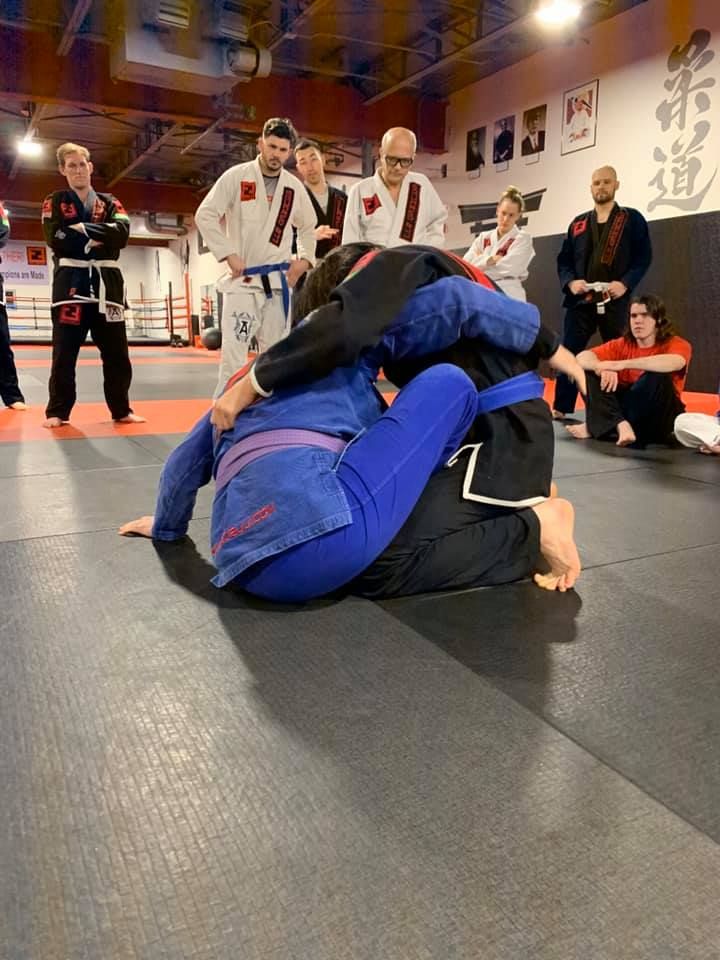
The biggest benefits of Brazilian Jiu-Jitsu for adults are full-body fitness, real stress relief, practical self-defense skills and a close community. Because you practice against partners who are actually resisting, you learn what works under pressure, not just in theory. And unlike many sports, people keep training well into their 40s, 50s and beyond.
Here is what BJJ does for your body and mind, how it holds up as self-defense, and what to know if you are starting later in life.
Fitness without the treadmill
BJJ is a workout that does not feel like one. A typical class mixes a warm-up, technique practice and live rounds, and those rounds hit almost everything:
- Cardio. A five-minute roll can leave you as winded as a hard run.
- Strength. You push, pull, lift and hold your own body weight and your partner’s.
- Mobility. Guard work and escapes build hip and shoulder flexibility over time.
- Grip and core. Holding positions and controlling a partner strengthens both.
Many people find they stick with BJJ longer than gym routines because they are focused on learning, not counting reps.
Stress relief and mental health
It is hard to worry about work email when someone is trying to hold you down. BJJ demands full attention, which gives your mind a real break. Many people walk out of class calmer than they walked in.
Over time, rolling also teaches you to stay calm under pressure. Being stuck under a heavier partner is uncomfortable at first. With practice, you learn to breathe, think and work your way out. Plenty of adults say that calm carries over into the rest of their life.
Problem-solving on the mat
BJJ is often called physical chess. Every position has counters, and every counter has its own answers. You learn to plan a step ahead, test ideas and adjust when something fails. That kind of learning keeps the brain engaged for years, because there is always another layer to discover.
Community and confidence
Grappling builds trust quickly. You train closely with the same people week after week, and you rely on them to keep you safe. Most gyms become a social hub, with people from very different jobs and backgrounds training side by side.
Confidence follows. Not the loud kind, but the quiet knowledge that you can handle yourself if things get physical.
Is jiu-jitsu good for self-defense?
Yes, with some honest limits.
What BJJ does well
- Control without striking. You can stop someone without having to hurt them badly, which matters legally and morally.
- Handling a bigger person. BJJ was developed so a smaller, technical person could deal with a larger, stronger one using leverage.
- Getting off the ground. If you are knocked down, BJJ teaches you how to protect yourself, create space and stand back up.
- Live practice. You test your skills against real resistance in every class, so you know what actually works.
Where BJJ has limits
- Multiple attackers. Going to the ground with one person is dangerous if their friends are nearby.
- Weapons. No martial art makes it safe to fight someone with a knife or gun.
- Strikes. Sport BJJ does not include punches. Adding some striking, through a program like MMA or kickboxing, rounds out your skills.
The best self-defense is avoiding a fight altogether: awareness, walking away and calling for help. BJJ is a strong backup plan if that fails. If you want to compare it with a throwing art, see BJJ vs judo.
BJJ after 40
Starting BJJ after 40 is common, and it is a good choice for many people. A few tips help:
- Tap early. There are no prizes for holding on. Tapping is how you stay healthy enough to keep training.
- Pick your partners. Roll with people who control their pace. Good gyms make this easy.
- Warm up properly. Ten minutes of mobility before class makes a real difference.
- Recover on purpose. Sleep, hydration and rest days matter more as you get older.
- Train consistently, not hard. Two or three steady sessions a week beat one exhausting one.
Competition also has room for older athletes. The IBJJF runs Masters divisions starting at age 30, with older age brackets above that. Gabriel Gonzaga, one of Squared’s head coaches, is a multiple-time IBJJF Masters World Champion, and Luis Soto is a Masters Judo National Champion, which shows how far grapplers can go past their twenties.
If you have injuries or health conditions, check with your doctor before you start, and let the coach know before your first class.
What about women and BJJ?
BJJ is a great fit for women, for many of the same reasons: leverage over strength, real self-defense practice and a strong workout. Many gyms have a growing number of women on the mat. Women who also want a striking workout can look at Squared’s women’s kickboxing program for ages 16 and up.
How soon will you notice benefits?
Most people feel fitter within a few weeks and calmer within the first month or two. Technical progress takes longer, as anyone who has read about how long it takes to get a BJJ black belt knows. But you will notice small wins early: your first escape, your first sweep, your first full round without gassing out.
Try BJJ in Leominster
Squared’s Brazilian Jiu-Jitsu program is for adults and teens 14 and up, with head coaches Gabriel Gonzaga (5th-degree BJJ black belt, 2x World BJJ Champion) and Luis Soto (6th-degree jiu-jitsu black belt). If you live in Leominster or anywhere nearby in central Massachusetts, book a free trial class and see what BJJ does for you.